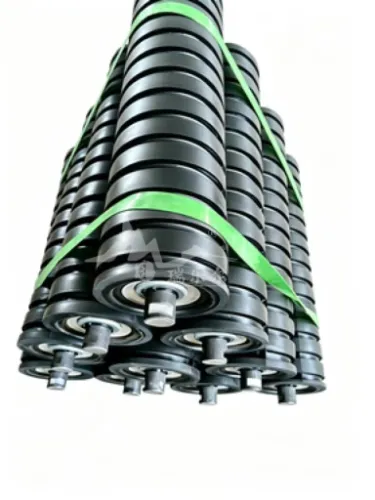
На що слід звернути увагу при виборі конвеєрних шківів?
Failures of conveyor pulleys such as shell deformation,shaft journal bending,rubber lagging delamination and bearing seizure are most likely not caused by service wear,but by improper model selection in the early stage.Once a pulley is incorrectly selected,it will not only result in premature scrapping of the pulley itself,but also trigger a series of cascading problems including belt deviation,belt tearing, equipment shutdown and soaring maintenance costs.

I.Fit actual working condition load.
The most common self-failures of conveyor pulleys include shell denting,deformation and shaft breakage,whose root cause is mostly insufficient load matching.
Therefore,the primary principle for pulley selection is working condition priority.Pulleys of different materials and models shall be selected according to the load capacity.It is necessary to comprehensively verify the belt width,conveying speed,material specific gravity,drop height and instantaneous impact load,and strictly distinguish light-duty,medium-duty,heavy-duty and reinforced-type pulleys to avoid structural fatigue damage.
II.Control of drum shell material and wall thickness.
The load-bearing capacity of the conveyor pulley shell is closely related to its material,wall thickness and structural design.
Ordinary rolled steel pipes are low in cost but feature poor pipe wall uniformity and numerous welds,making them suitable for general conveying scenarios that are dry,light-duty and free of impact.
Seamless steel pipes are integrally formed with fewer welds and higher strength,serving as the mainstream choice for the mining, sand and coal industries.
For humid and corrosive working conditions,pulley shells with anti-corrosion spraying,galvanized treatment or stainless steel material are required.
III.Scientific selection and matching of conveyor pulley lagging.
The functions of pulley lagging include increasing friction,anti-slip and wear resistance,protecting the belt and cushioning impact,making it an indispensable configuration for drive pulleys.


Plain rubber lagging is suitable for conventional working conditions that are dry,free of ponding and with low dust.
Diamond patterned lagging delivers excellent drainage and mud removal performance,ideal for open-air,humid and muddy environments such as ports and stone plants.
Ceramic lagging features the highest wear resistance coefficient,applicable to main conveying lines with high abrasion,large throughput and long-distance transportation.
Polyurethane lagging features excellent anti-slip performance, good waterproof and moisture-resistant properties, as well as shock absorption and cushioning effects. It is suitable for heavy-duty and harsh working conditions such as mines, gravel plants and ports.
IV.Bearing and sealing system selection.
When selecting bearings for conveyor pulleys,heavy-duty spherical roller bearings must be adopted for heavy-load working conditions,and ordinary ball bearings shall not be used in heavy-load applications.The bearing pedestal adopts an integral cast steel structure,which is not easy to deform under stress.

The sealing structure affects the service life of conveyor pulleys.High-quality pulleys adopt a combined sealing design of multi-layer labyrinth seal,skeleton oil seal and dust baffle ring,which provides multiple barriers to prevent dust and moisture from entering the inner cavity.
V.Reasonably match the pulley diameter and width.
The selection of the roller diameter shall strictly match the standard size according to the conveyor belt ply number,tension grade and belt speed.
Under normal circumstances,the diameter of the drum should not be too small,so as to ensure sufficient wrap angle and friction.For high-strength and high-speed conveyor belts,a larger pulley diameter is required to reduce belt bending fatigue and protect both the belt and the pulley.
The conveyor pulley width shall be 100–400 mm wider than the belt width,to avoid edge wear of the belt,reduce the risk of belt deviation,and ensure stable operation.


VI.Match the transmission mode with the installation position.
The drive pulley must be lagged to ensure sufficient friction and wear resistance.
Bend pulleys and take-up pulleys shall adopt smooth surface or simple lagging according to tension and service environment.
The head, tail and middle pulleys bear different forces, and their structural strength shall be matched according to the installation position.
VII.Environmental adaptability selection.
High-temperature environments adopt high-temperature resistant rubber,heat-resistant bearings and special lubrication solutions.Low-temperature environments use low-temperature resistant materials to avoid brittle fracture.
In explosive or dusty environments,the equipment shall comply with explosion-proof requirements to eliminate risks of static electricity and sparks.For underwater or high-humidity environments,enhanced waterproof sealing and anti-corrosion treatment shall be adopted.
VIII.Dynamic balance and machining accuracy.
High-speed and high-power conveyors must undergo dynamic balance treatment to reduce vibration,noise and bearing wear,and ensure stable operation.
IX.Safety and standard compliance.
The design and manufacture of pulleys shall comply with internationally accepted standards.Their structural strength,safety factor and shaft end dimensions shall meet equipment requirements to eliminate potential safety hazards.
Схожі новини
- Які правила техніки безпеки для гірничих стрічкових конвеєрів?
- Які основні причини високого споживання енергії в системах приводу конвеєрів?
- Як ефективно запобігти прослизанню конвеєрної стрічки?
- Інструкція з вибору основного очищувача
- Які запобіжні заходи щодо технічного обслуговування та ремонту конвеєрних стрічок?
- Які ключові ролі виконують нижні комплекти направляючих роликів, що самовирівнюються, у важких умовах експлуатації?
Залиште мені повідомлення